

Bowmer & Krikland
£11m
Newcastle
72 weeks
Project Description
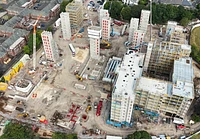
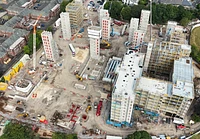
The Castle Leazes student accommodation development for Newcastle University is being delivered as a joint venture with Unite Students, with Bowmer and Kirkland acting as main contractor. As concrete subcontractor, Cidon is responsible for delivering the structural package of twenty-six reinforced concrete slipformed cores within a 52-week programme.
Our scope focuses on constructing the primary vertical structural elements that stabilise and service the four- to nine-storey residential buildings forming the new student village.
The works have been sequenced to deliver two slipformed cores consecutively throughout the duration of the project. This approach has established a rolling cycle, ensuring continuous utilisation of slipform rigs, labour and supervision, while maintaining steady vertical progression across the site.
Slipforming was selected as the preferred construction methodology due to its suitability for repetitive vertical structures and its ability to accelerate the programme compared with traditional jumpform systems. The continuous pouring process enables consistent wall thickness, alignment and finish quality, while reducing reliance on craneage and temporary works. This method supports both efficiency and quality control across all twenty-six cores.
The project scope and programme requires detailed logistical coordination. All deliveries are carefully aligned with the rolling programme to ensure there is no interruption to the cycle.
The Castle Leazes development represents a significant investment in high-quality, modern student accommodation and forms part of Newcastle University’s long-term estate strategy. For Cidon, the project demonstrates our capability to deliver complex slipformed concrete structures safely, efficiently and in line with demanding programme requirements.
Unique Features
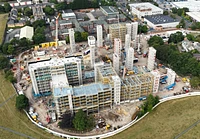
- 25 slipform cores
- Two-core rolling sequence
- Effective subcontractor management and coordination
- Comprehensive logistics management
- Drawing control and technical management
- Quality assurance and Gateway Two compliance